17 th June 1956 – 21 st October 2025
Michael was born on 17th June 1956 at No 58 Whalley Road in Manchester. He
grew up alongside his elder brother, Alan, and his sister, Lynn. His family was closely
connected to the Royal Air Force, as his father served in the RAF. This commitment
led the family to relocate frequently, accompanying his father on postings across the
United Kingdom, as well as to Singapore and Cyprus.
During their time in Cyprus, Michael experienced a life-altering incident. Whilst
travelling on a bus, a stray bullet passed through the vehicle, resulting in shrapnel
being embedded in his legs—a lasting reminder of the event that remained with him
for the rest of his life.
Unable to pursue a career in the RAF like his father, Michael had a varied
professional life. He worked at ICI test paint, watching paint dry was not for Michael
so he moved to De Beers sorting diamonds, the NHS as a plaster technician at
Lewisham Hospital, in the back office of the Stock Exchange, and on earthquake
early warning systems at Seismograph Systems in Keston.
In the later years of his career, Michael found immense satisfaction and fulfilment
working within the field of driver education. Beginning as a driving instructor, he
dedicated himself to helping others develop the skills and confidence necessary for
safe motoring. His commitment and expertise led him to progress to the role of
Driving Examiner, where he became known for his professionalism and
encouragement of learners. Michael ultimately rose to the position of Chief Driving
Examiner for South East England. For many individuals, Michael was a reassuring
and influential presence during their formative driving experiences, leaving a lasting
impression on all those he guided through the process of learning to drive.
Michael possessed a diverse repertoire of hobbies, including boating, piloting
aircraft, and wild camping. At times, these pursuits led to challenging situations; for
example, he was involved in a plane crash at Biggin Hill from which he fortunately
walked away unharmed. Additionally, his yachting activities required rescue by the
RNLI on two occasions, with part of one incident documented in a YouTube video. He served as a co-pilot with Richard Branson, flew “booze cruises” to Le Touquet, and piloted trips to Malta. In terms of sailing, he frequently visited the Thames estuary and occasionally travelled further into Europe.
Who knew he was an aficionado of Lego, the bigger and more complex the better; a NASA rocket and Land Rover to name but a few of his creations. It seems fitting that a Lego rose bouquet will be adorning his coffin enroute to his funeral service.
Michael was a member of the Free Masons and served as the Master of Knole Lodge.
His music preferences included AC/DC, The WHO, and Tubular Bells. While Country
was not his preferred genre, his favourite song was “I Love You More and More” by
Joe Dolan.
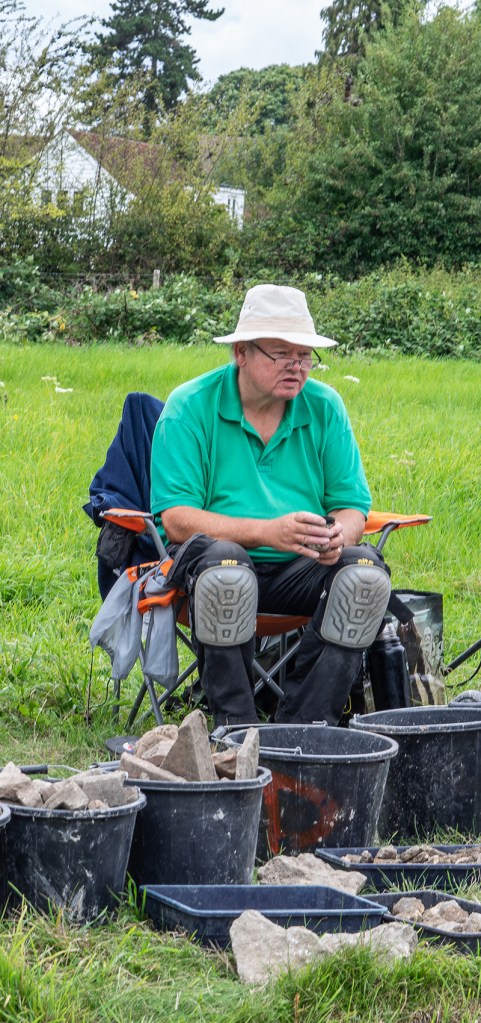
Later in life, archaeology became a primary interest for Michael. His curiosity and
capacity for learning allowed him to contribute to the study of archaeological sites.
He engaged in excavations and participated in discussions regarding interpretation.
Michael’s approach to archaeological interpretation was analytical and drew the
involvement of others. As Michael’s health declined, he shifted from dirt archaeology
to drone and site photography, though his interpretive analysis grew stronger.
Michael joined the Kent Archaeological Society and became a Trustee in 2016, a
role he held until 2024. During his time as a Charity Trustee, the Society transitioned
to become a Charitable Incorporated Organisation (CIO), a significant milestone in
its development. Michael played a pivotal role in initiating two major archaeological
projects: The Lees Court Estate Project and the Trosley Court Heritage Project. His
leadership and dedication were instrumental in bringing these important projects to
fruition, contributing meaningfully to the Society’s enduring legacy.
Michael was a passionate advocate for archaeology, dedicating considerable time
and energy to advancing the discipline. He not only participated in lectures, sharing
his knowledge and insights with others, but also supported community archaeology
groups by offering his expertise in drone technology to assist their work.
Perhaps most significant was Michael’s commitment to educational outreach. He
frequently visited local schools, where he took great pleasure in teaching students
about their heritage. Michael had a natural ability to engage young people, inspiring
their curiosity and enthusiasm for learning about the past. During these visits, he
encouraged students to explore and question their history, fostering a deeper
appreciation for archaeology—a reward that he found deeply fulfilling.
Michael’s engaging approach often included hands on demonstrations and
interactive elements. Notably, he created a replica xylospongium, much to the delight
and amusement of his younger audiences. This inventive teaching method not only
captured the imaginations of students but also made history accessible and
memorable, leaving a lasting impression on all who took part in his sessions.
Michael’s enthusiasm for archaeology was not confined to his own endeavours; it
naturally extended to his family. His loved ones received an informal yet thorough
education in the subject, as they became very familiar with popular programmes
such as Time Team and Digging for Britain.
Michael found a strong sense of belonging within his local community archaeology
group, the Discover Roman Otford Project. This group became his archaeological
home, providing a welcoming environment where his passion for archaeology and
history and his varied skill set could be fully utilised.
The project focused on the excavation of a complex collection of Roman buildings, a
challenging endeavour that brought together all of Michael’s experience and
expertise. His analytical approach, technical proficiency, and enthusiasm for
collaborative work made him an invaluable member of the team. Through his active
participation in these excavations, Michael was able to further his engagement with
the field and continue making meaningful contributions to community archaeology.
Michael embarked on a Bachelor of Arts in Archaeology, demonstrating his
continued commitment to learning and personal growth. Unfortunately, the
progression of cancer had a profound impact on his studies. Despite his
determination and perseverance, the illness prevented him from completing his
degree, leaving him just one course module short of graduation.
In his final years, Michael faced serious health challenges, beginning with multiple
sclerosis and ending with cancer. True to character, he managed these illnesses with
stoic pragmatism and persistent determination, refusing to let them slow him down,
ably supported by his family.
After his terminal diagnosis, Michael began working through his bucket list, including
getting a tattoo to commemorate being a 2012 London Olympics Games Maker. He
completed his last item, a gyrocopter flight, the Thursday before he died on the
following Tuesday.
Michael enjoyed a traditional courtship with Catherine, marked by warmth and
genuine affection. Their relationship was, for the most part, straightforward and filled
with happiness. However, there was one particularly memorable episode that stood
out in its uniqueness. On one occasion, Michael found himself hastily bundled into a
wardrobe to avoid being discovered during an unexpected visit from Catherine’s
parents to her nurses’ accommodation.
Michael is survived by his beloved wife, Catherine, who was not only his spouse but
also his best friend and lifelong companion. He leaves behind his cherished children:
Susan, Jennifer, Mark, and Elizabeth. Michael was also a devoted grandfather to his
seven grandchildren—William, Phillip, Calie, Connor, Daisy, Finley, and the newest addition
to the family, two-week-old Archie.

 DROP
DROP 